Skagway
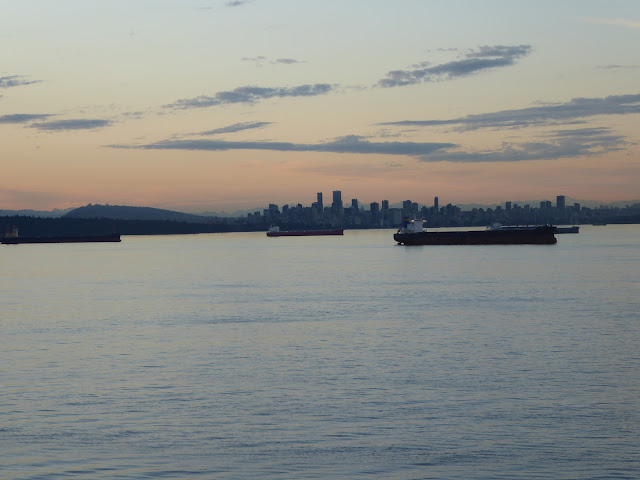
Arrrrgh!! Woke up at 5:30 AM, way too early for me! Decided to peek out the window to see what there
was to see. Wow!! Made waking up early
not a bad thing. This is what I saw.


Stunning – we were travelling up a narrow channel, heading toward our stop for the day Skagway. This is the northernmost point of our trip.


In 1900, Skagway was incorporated as the first city in the Alaska Territory.
One prominent citizen of Skagway, and one might argue, a founding father, was William "Billy" Moore, a former steamboat captain. As a member of an 1887 boundary survey expedition, he had made the first recorded investigation of the pass over the Coast Mountains, which later became known as White Pass. He believed that gold lay in the Klondike because it had been found in similar mountain ranges in South America, Mexico, California, and British Columbia. In 1887, he and his son, J. Bernard "Ben" Moore, claimed a 160-acre homestead at the mouth of the Skagway River in Alaska. Moore settled in this area because he believed it provided the most direct route to the potential goldfields. They built a log cabin, a sawmill, and a wharf in anticipation of future gold prospectors passing through.
A mere ten years later, on July 29, 1897, the steamer Queen, docked at Moore's wharf with the first boat load of prospectors. More ships brought thousands of hopeful miners into the new town and prepared for the 500-mile journey to the gold fields in Canada. Moore was overrun by lot jumping prospectors and had his land stolen from him and sold to others. By June 1898, with a population between 8,000 and 10,000, Skagway was the largest city in Alaska. By 1899, the stream of gold-seekers had diminished and Skagway's economy began to collapse.
Today, Skagway, with a population of just over 1,000, deals with another gold rush of sorts, as over 900,000 visitors a year, primarily cruise passengers, arrive. Most arrive and depart between early May and mid October. It's nickname is "Gateway to the Klondike" as it was the start of the Chilkoot trail that lead up into the Klondike gold fields. Tourist trains of the White Pass and Yukon Railway still run along part of the route.
Some pictures along the way:


Stunning – we were travelling up a narrow channel, heading toward our stop for the day Skagway. This is the northernmost point of our trip.
Passing by Haines, Alaska

Today, for the first time, we have company in port, the 700 passenger Seven Seas Mariner. Our weather is holding – the temperature is supposed to be about 60 plus, no rain in sight and no wind. We could not ask for more.

One prominent citizen of Skagway, and one might argue, a founding father, was William "Billy" Moore, a former steamboat captain. As a member of an 1887 boundary survey expedition, he had made the first recorded investigation of the pass over the Coast Mountains, which later became known as White Pass. He believed that gold lay in the Klondike because it had been found in similar mountain ranges in South America, Mexico, California, and British Columbia. In 1887, he and his son, J. Bernard "Ben" Moore, claimed a 160-acre homestead at the mouth of the Skagway River in Alaska. Moore settled in this area because he believed it provided the most direct route to the potential goldfields. They built a log cabin, a sawmill, and a wharf in anticipation of future gold prospectors passing through.
A mere ten years later, on July 29, 1897, the steamer Queen, docked at Moore's wharf with the first boat load of prospectors. More ships brought thousands of hopeful miners into the new town and prepared for the 500-mile journey to the gold fields in Canada. Moore was overrun by lot jumping prospectors and had his land stolen from him and sold to others. By June 1898, with a population between 8,000 and 10,000, Skagway was the largest city in Alaska. By 1899, the stream of gold-seekers had diminished and Skagway's economy began to collapse.
Today, Skagway, with a population of just over 1,000, deals with another gold rush of sorts, as over 900,000 visitors a year, primarily cruise passengers, arrive. Most arrive and depart between early May and mid October. It's nickname is "Gateway to the Klondike" as it was the start of the Chilkoot trail that lead up into the Klondike gold fields. Tourist trains of the White Pass and Yukon Railway still run along part of the route.
We had not planned any excursions today, but as the weather was so nice, we decided to take the White Pass and Yukon rail trip, up to and just beyond the Canadian border. Once again, we were fortunate, walked off the ship and got right on the 9 AM train. It was a 3-hour round trip, on a narrow gauge (3 feet) rail line, very comfortable and stunning scenery almost all the way. We climbed from sea-level to just about 3,000 ft in just over 20 miles.
Some pictures along the way:
just and interior of the car we were in, one of 13 n this train and we were the last car


acrss te vally is the highway heading in to Skagway from Carcross in the Yukon and to the right you can see the raiway grade we have been climbing 


Inspiration Point - that is Skagway harbour you see off in the distance

Dea Horse Gulch - over 3000 pack animals lost their lives transporting goods


heading towards a tunnel


Decommissioned cantilever trestle bridge


Our locomotive up ahead


Sign post on the original "Trail of 98"

We have reached our destination, the Fraser Valley, just beyond White Pass summit and out turn around spot for the journey back to Skagway


Lake ice is starting to melt


remains of a winter snow slide/avalanche that had blocked the tracks


back in Skagway - the Arctic Brotherhood building

Harbour rock signs with names and dates of visiting ships


Celebrity Eclipse at anchor in Skagway

Across te way the Seven Seas Mariner and the Alaska State Ferry Columbis

first to leave was the Seven Seas Mariner, backing up out of the harbour

then the side thrusters were engaged and in less than 2 1/2 minutes she had spun 180 degrees on a dime and was heading away to her next destination

shw was followed close behind by the Columbia, performing the exact same maneuver

a couple of hours later we did the same thing and were also on our way


Comments
Post a Comment